
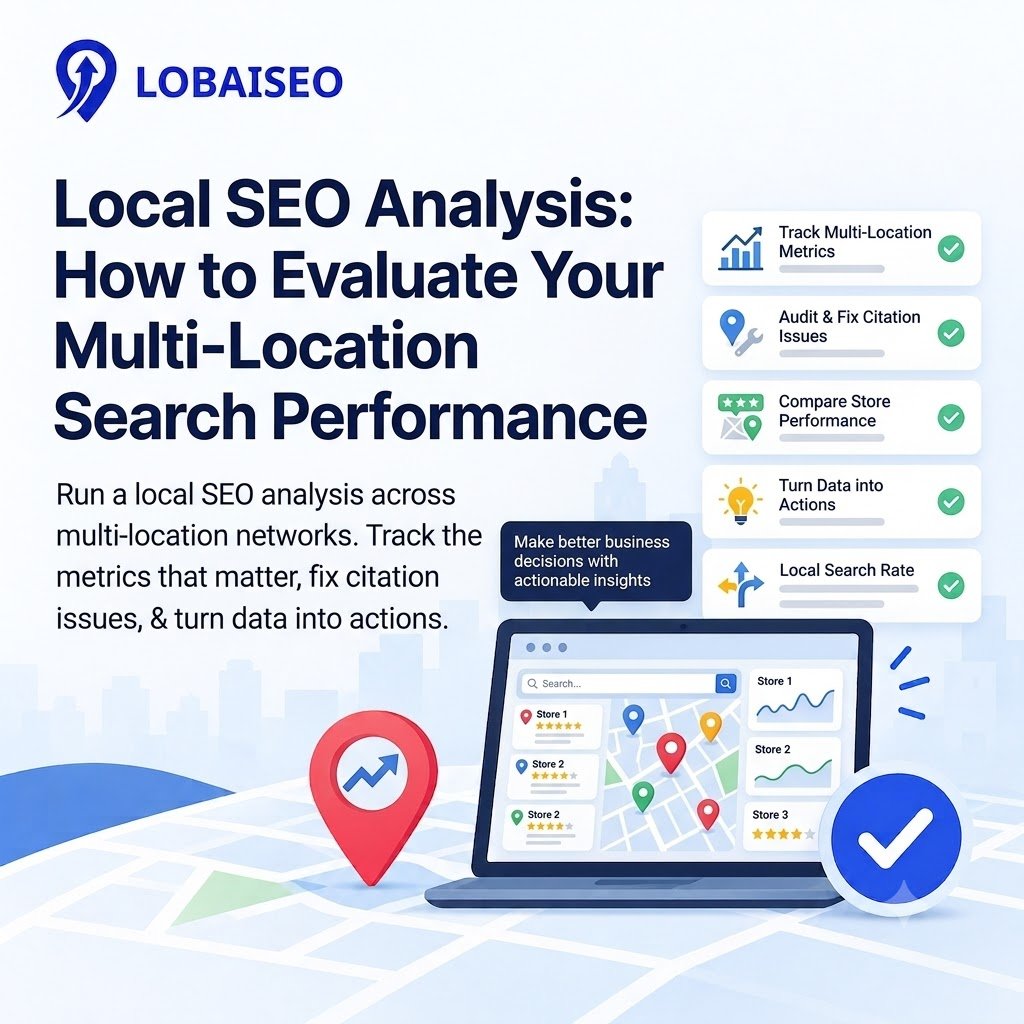
We manage bulk Google Business Profiles every day. Dealer networks in Tier-2 cities, hospitality chains, and AC service companies. The problems repeat themselves. A dealer in a small town edits the business name without telling headquarters. A franchise location moves to a new address, but the old listing stays live. A hospitality chain has 40 profiles with 40 different phone number formats.
Google sees conflicting signals. It stops trusting the entity. Rankings drop. Calls stop coming. At Lobaiseo, we see this pattern across dealer networks, hospitality chains, and service companies that leave local search unmanaged.
This guide shows you how to run a local SEO analysis that actually catches these problems before they cost you revenue. We will cover the metrics that matter, the tools that surface real issues, and how to turn raw data into actions your team can execute.
Here is the reality most enterprise brands miss: Your Google Business Profile is not a listing. It is a live content feed for Google and AI search systems. When it goes stale, you disappear from the places customers actually search.
Which Metrics Matter in Local SEO Analysis?
Most local SEO performance reports fail because they focus on vanity numbers. Impressions go up. Rankings fluctuate. But the phone still does not ring. The real question is simpler: are people finding you, and are they taking action?
Google Business Profile Insights gives you the raw data. You can see search queries that triggered your profile, total profile views, direction requests, phone calls, and website clicks. These are the metrics that sit close to revenue. A direction request means someone wants to visit. A phone call means they want to buy.
For multi-location brands, location-level reporting matters more than brand-level averages. A national brand might look healthy overall, while 30 locations have stale photos and unanswered reviews. We have seen dealer networks where half the locations had blank profiles while headquarters had no idea. You need to segment by location, not just aggregate.
Competitor benchmarking adds the context that raw numbers miss. Traditional brand-level tracking tells you who your national competitors are. It does not tell you who is beating your downtown location on a specific search result.
How Do You Turn Local SEO Data into Actions?
Data without action is noise. The most common failure we see is teams that export reports, review them in meetings, then change nothing. The workflow needs to be tight: identify the problem, assign an owner, fix it, and verify the fix.
Start with citation consistency. If your NAP data differs across Google, Yelp, Apple Maps, and industry directories, Google does not know which version to trust. Fix the Google Business Profile first, then update Tier-1 platforms, then move to aggregators. Expect map pack movement in 30 to 60 days, with full cleanup taking 90 to 120 days. This is not glamorous work, but it is the foundation.
Review management is the second lever. BrightLocal data shows 63% of consumers expect a review response within two to three days. More importantly, recent reviews carry more weight than old ones. Ten reviews from this month outperform 200 reviews from two years ago . Set up a system to ask every satisfied customer for a review. Automate responses so nothing sits unanswered.
For local ranking analysis at scale, focus on the gaps between your best and worst locations. If one location ranks well and another does not, the problem is usually profile completeness, review recency, or citation accuracy. Fix the bottom performers first. That is where the biggest gains are. For teams managing hundreds of profiles, platforms like Lobaiseo automate the posting and review response layer, but the strategic decisions still need human review.
FAQs
Local SEO analysis is the process of evaluating how your business appears in local search results. It covers Google Business Profile performance, citation accuracy, review health, and ranking positions across service areas.
How do I analyze local SEO performance?
Start with Google Business Profile Insights. Track profile views, calls, direction requests, and website clicks. Compare month over month. Then audit your citations, review response times, and competitor rankings.
What metrics should local businesses track?
Focus on calls, direction requests, website clicks, and review volume. These connect directly to revenue. Impressions and rankings matter as context, but they are not the goal.
How often should local SEO be analyzed?
Run a full audit every six to twelve months. Review key metrics monthly. For multi-location networks, location-level checks should happen weekly or biweekly.
Can local SEO analysis be automated?
Yes. Tools like Lobaiseo automate profile monitoring, review tracking, and ranking checks across hundreds of locations. But someone still needs to review the data and make decisions.
One thought on “Local SEO Analysis: How to Evaluate Your Local Search Performance”